EUDR: Updates for 2026
%20(4).png)
EUDR Updates for 2026
For sustainability professionals 2025 has been a tumultuous year. Starting with the EUs Omnibus on sustainability, and ending with an overhaul of its Deforestation Regulation, the year brought about several changes to Europe’s sustainability framework. For businesses this has resulted in a lot of uncertainty. Companies that had previously begun to comply with the regulations targeted by these revisions are now working to adapt their strategies to the latest changes in the legislation.
The purpose of this article is to discuss some of these changes. Particularly, it will focus on the alterations made by the European Union to the European Deforestation Regulation (EUDR). To do so, this article is divided into four main sections: An introduction to the legislation, its objectives, and basic requirements, a background to the changes made to it in December, the changes themselves, and finally how can businesses stay ahead of these changes and avoid any uncertainty.
To facilitate navigation you can click any of the links below to skip directly to any section you might want to visit:

The EUDR in a nutshell
The European Regulation on Deforestation-Free Products (EUDR) is a seminal legislative instrument, proposed by the EU, to reduce its exposure to deforestation in its supply chains. It works by targeting 7 high-impact commodities, cattle, cocoa, coffee, oil palm, rubber, soy, and timber as well as products derived from them, and limiting their entry into Union markets.
Proposed as part of the EU’s Green Deal in 2023, the regulation applied to companies operating in the Union that handled these commodities. It required them to establish systems to ensure products were sourced from deforestation-free areas and that they remain traceable throughout their entire lifecycle. Within this framework, businesses were obliged to submit any and all information pertaining to the production, import, and processing of relevant products as due diligence statements on the EU’s TRACES portal.
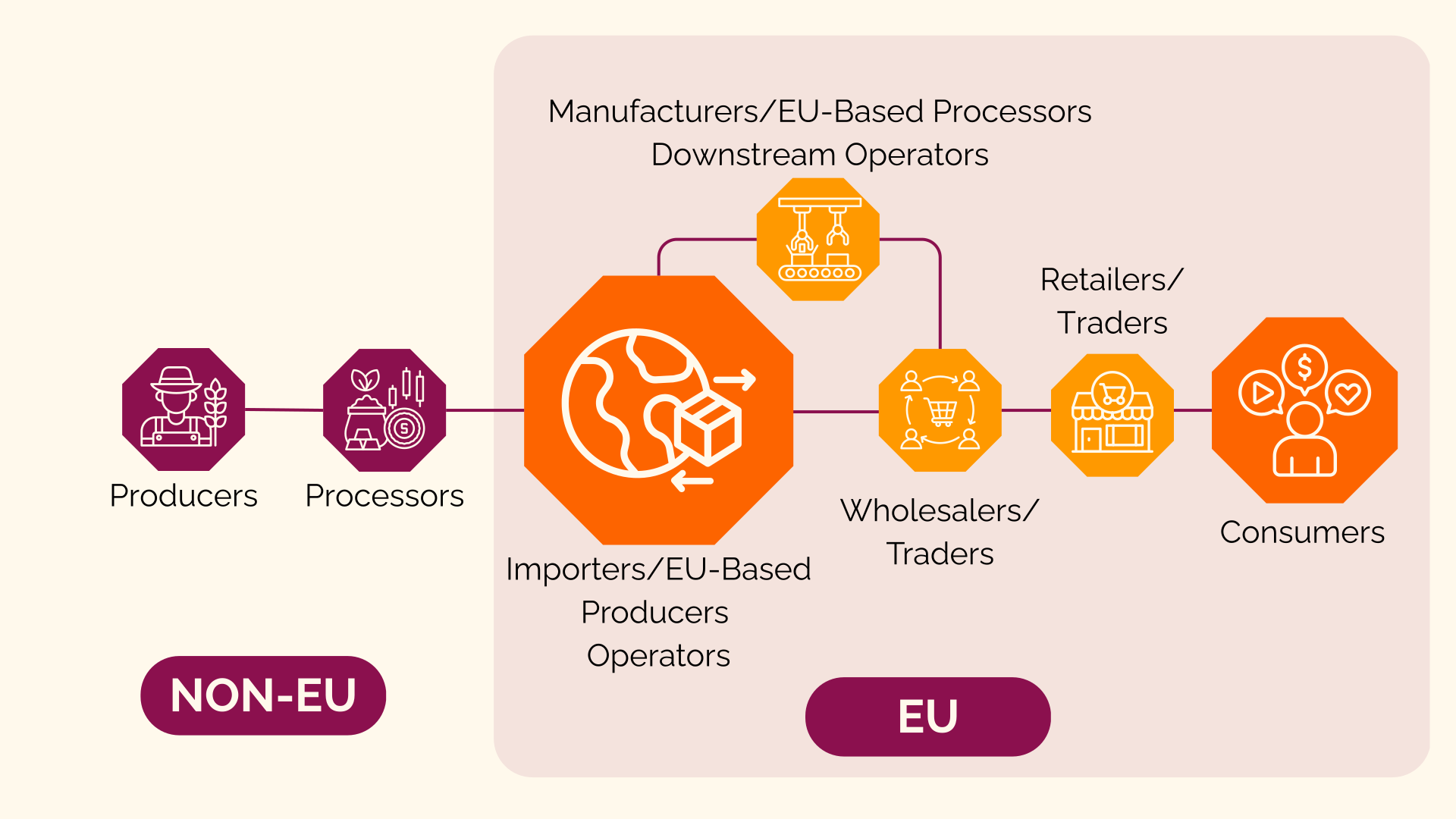
To achieve this, the EUDR targeted businesses both upstream, and downstream of their respective supply chains. Upstream businesses, classified by the regulation as operators, would be obliged to conduct an in-depth risk assessment to determine deforestation-risks in their supply-chains. Downstream businesses, or traders, would have to ascertain whether upstream risk assessments had been conducted properly and if items were indeed deforestation-free.
In this framework responsibilities are shared among companies within given supply chains. SMEs, especially SME traders, would follow a simplified regime wherein no risk assessments are required for compliance with the regulation.
This version of the EUDR was set to apply from the beginning of 2026. However, nearing the end of 2025, several changes were proposed to the regulation, including a one-year delay in application.
Background
Two months before the EUDR was set to come into force, European lawmakers were informed that the EU’s TRACES system would not be ready to handle the expected volume of information from 2026 onwards. In a letter to the European Parliament, EU Commissioner Jessika Roswall called for the adoption of an urgent procedure to delay the regulation by one year citing issues with TRACES as the main reason for the proposed delay. However, this was met with pushback from, among others, Commission Vice President Teresa Ribera. In conversation with Roswall, however, the two found a compromise: An effective 6-month delay and simplifications for micro and small producers so as not to overburden the system.
Despite this compromise, authorities within several EU countries, and parliamentarians saw this as an opportunity to introduce further simplifications to the regulation. The amended proposal created by Ribera and Roswall was put to a parliament vote on December the 17th along with several other amendments, not least of which, the one-year delay provision was resurrected. During the vote, parliament decided with 405 votes in favor, 242 against, and 8 abstentions to delay the regulation by another year.
Main changes
Aside from being delayed by another year, the EUDR was also the subject of several other changes. The main changes approved by the European Parliament and published in the EU’s official diary are:
- One-year delay: A one-year delay of the application date to 30 December 2026, plus an extra six-month extension for small and micro primary operators to June 30, 2027. Following the first EUDR delay in 2024, this marks the second time the regulation has been delayed by one year.
- First Placer Focus: Shifts the regulation’s focus to first placers, upstream entities who import EUDR relevant products into the Union. Restricting the obligation to collect and transmit due diligence statements to the Operator, and only up to the first downstream operator in relevant supply chains; subsequent operators are exempt.
- Simplified rules for Micro and Small Operators: Micro and Small operators would only require a simplified, one-time declaration in place of the full due diligence process requiring less detailed information (e.g., postal addresses instead of full geolocation data).
- Printed products exemption: Exempts printed products such as books and newspapers from the EUDR, despite paper being a relevant product.
- A backdoor for further simplification: A requirement for the Commission to submit a report by 30 April 2026 outlining potential further simplifications for the regulation.
How to avoid uncertainty
The Parliament’s 11th-hour changes have left many businesses, especially SMEs, unsure of their exact EUDR requirements. With another simplification review expected by June 2026, the private sector remains in a 'wait-and-see' mode, facing a prolonged period of regulatory instability.
While fully avoiding uncertainty is generally impossible, there are numerous strategies businesses can take to stay ahead of EU regulatory changes:
- Be Proactive: Monitoring legislative shifts is time-consuming, but anticipating requirements remains the safest strategy. While companies that invested in full EUDR compliance prior to the Parliament’s amendments may feel frustrated by the moving goalposts, their efforts have not gone to waste. Comprehensive supply chain mapping does more than satisfy a single regulation, it identifies hidden risks, streamlines logistics, and prepares the organization for the broader wave of "Green Deal" transparency requirements.
- Be flexible: Aside from legal checkboxes, the data you collect for the EUDR is essentially a high-definition map of your business's physical reality. In the modern economy, this transparency is a "new currency" that can be spent on operational efficiency, risk management, and brand equity. Being flexible in how you use this data can reveal bottlenecks and allow you to invest in risk-avoidant alternatives to keep your business running smoothly
- Be Informed: The compliance burden for sustainability-related regulations is increasingly diffusing across every facet of a company’s operations. Gone are the days when environmental reporting was siloed within a single ESG department; today, it impacts Procurement, Legal, Logistics, and even Finance. Investing in the continuous education of multiple departments ensures that compliance requirements are translated into actionable operational goals.
If your business still needs help setting up a sustainability strategy that foresees, and adapts to evolving regulatory compliance needs, we can help! Send an email to our ESG compliance experts through the form below!
I agree with the privacy policy and terms and conditions Thank you for your contact request. We will make sure it gets to the right specialist. An error has occurred, please try again later of contact us by phone or email.